Superposition and Entanglement
Classical computers push bits around with and, or, not. Quantum computers add two more moves: superposition and entanglement.
A quantum bit (qubit) can sit between 0 and 1. The Hadamard gate H parks it exactly in the middle, so a measurement comes out 0 half the time and 1 the other half. Try it on the Bloch sphere below. What happens if you press the H button?
That is superposition, and you already know it. It is a coin flip. Measuring collapses the qubit to a plain 0 or 1, so a single run tells you almost nothing. You run the same circuit hundreds of times and read the statistics instead. Those runs are called shots.
Entanglement is the part coin flips do not prepare you for. Two qubits can be wired so their results always agree: both heads, or both tails. Neither outcome is decided in advance, and the two simply match. Each individual result is still random, while the set of results that can occur has shrunk from four to two.
Neither idea is exotic: both computing traditions grew out of the same nineteenth-century algebra.
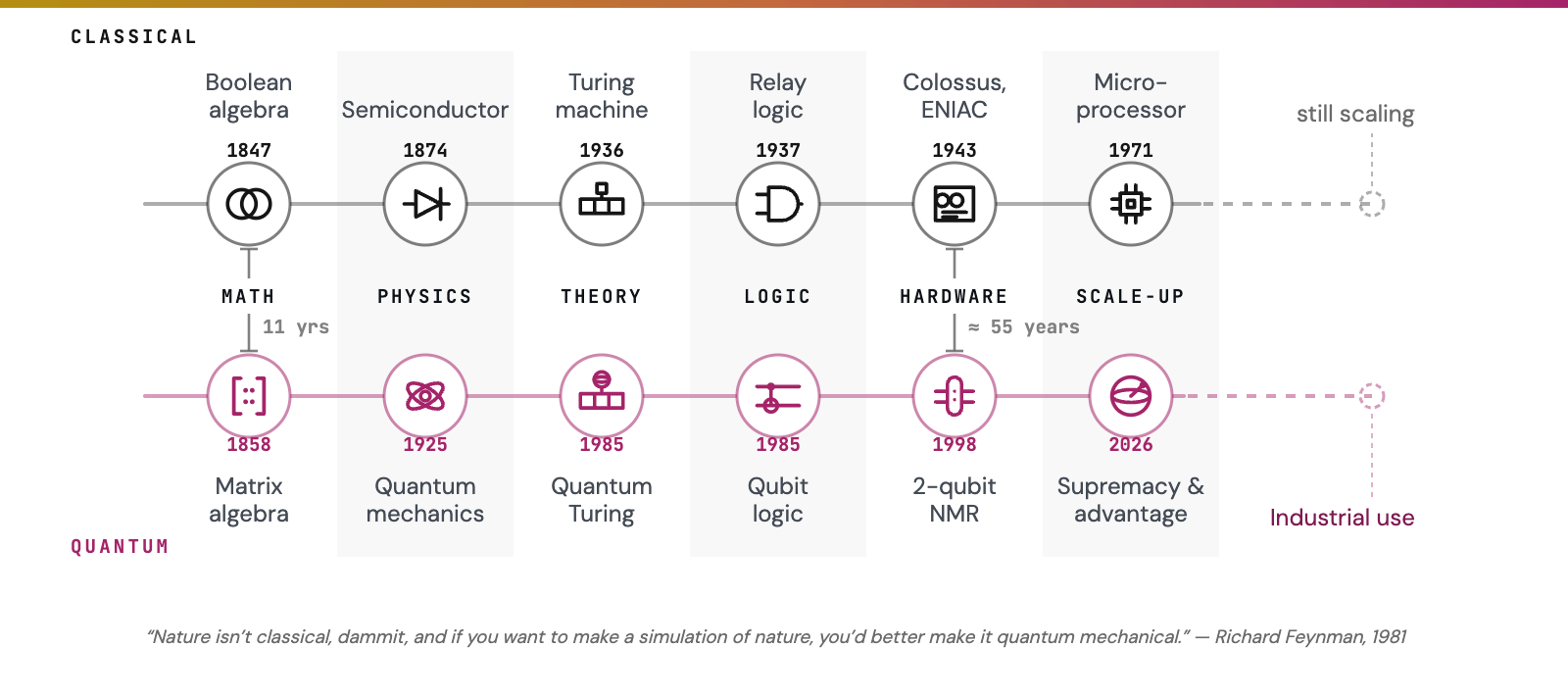
Every quantum milestone lands roughly fifty years after its classical twin. Qubits are tiny and unstable, and that costs time. Closing the gap takes specialists from every profession, not only physicists. You, right now, working through the tutorial. From the Kipu team, a big ♥-thank you.
About our approach
The hands-on tutorial this primer belongs to runs seven steps. Six have you write a small Python file and run it from a terminal, so you finish with a project folder you can come back to. The seventh maps the Kipu Quantum Hub around your circuit.
A note about hints in this course
Tasks come with collapsed hints. Before opening one, guess. If a colleague or a chatbot you trust is nearby, argue it out first.
Hints come in three tiers. Hint 1 points at the docs page or the command that surfaces the answer and gives none of it away. Hint 2 describes the shape of what you are reaching for. The Solution is full working code with a copy button, run against the live Hub on 4 August 2026, the date recorded as lastTested on the tutorial. Step 6 skips Hint 2, because its task is mechanical rather than conceptual.
Opening the Solution first gets you nothing out of the page.
Ready for the hands-on part? Start the hands-on tutorial.